Stick and Stones and Bones and Ink and things...
Drawing in the Pyrenees in Spain, with the Artists for Nature Foundation in 2002, my wildlife art hero, Robert Bateman once said; "I found this stick. It is not an outstanding stick! It is just any old stick and broke it off. I've done this before. I often..., I don't bring a pen. I just wait until I see what is around to draw with and you get these happy accidents so that I move the stick around I not ever sure if it is going to be three lines, or one line, or a smudge, or I could rub areas with it, but the point is it is varied and surprising." He also says; "A great teacher once said in order to learn how to draw you have to make at least ten thousand mistakes. Get busy and start making them!"
It has been a little while, now. I need to get back into my drawing. So, I need to go make some mistakes! What better way to do that, than to draw with a stick and a stone. So unpredictable, might provide a surprise or two. So here goes... drawing without traditional materials, no pen, no pencil, no brush...
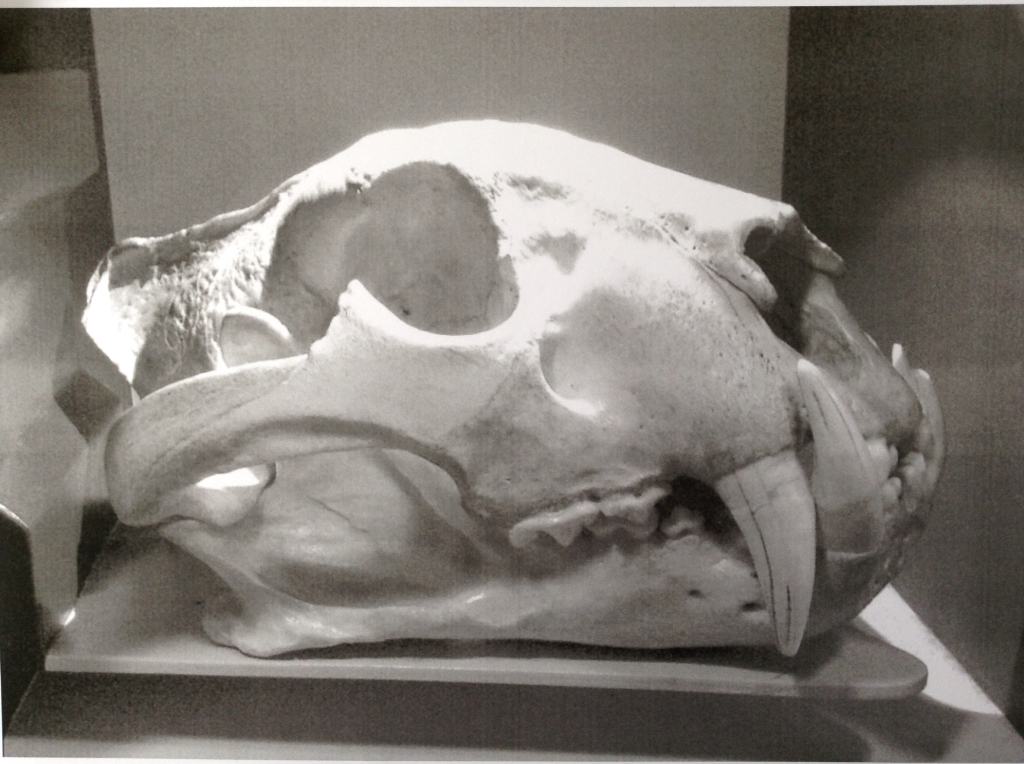
Something interesting to draw... a few days ago, I popped into my local museum, the Castle Museum Norwich, to take some snaps of bones in the natural history department. A fossil skull of a thunder-bird (an extinct giant) and a skull of a polar bear caught my eye. I printed out the photos in black & white.

Today, I selected from my garden some natural materials to draw with; a dry stick, some pebbles, some dry birch bark and soft wood I'd collected some time ago from Mousehold Health, even some egg shells saved from the kitchen.

The question... do I try some mark-making first to see how these will work with some black ink? Or, do I go for the varied and surprising approach. Of course, I want to get straight into it.
My first drawing looks a little tentative to me. An outline drawn with stick. A few smudges and varied marks with bark. But basically a line-drawing...

Time for another go. This time, I gone straight into some darks by putting in a black background. That will stop the appearance of an outline..!

This is definitely more tonal and more three-dimensional. It also looks more scary! Or do I mean gory? Proportions are not perfect but then this is a free-hand drawing, so that's okay. Big teeth. It is definitely a monster!
Over all, I am quite pleased. I will certainly try this technique again. It should be a great technique for some field sketching. I may look for more varied natural materials to work with... a pine cone, sponge, feathers, those egg shells I didn't use. Or perhaps, I should just wait to look around to see what to draw with, just as Robert Bateman would do.
A final thought - one for the future. I have seen similar ideas in books, using charcoal instead of manufactured ink. As a dry powdery material, I would guess a stick or a stone would be less effective than something softer, say a finger-tip, a bundle of grass, feathers, just something to smudge. Perhaps a hard or sharp tool could be used to scratch away an image from the smudged charcoal. And of course, charcoal comes as a ready made stick for lines.


